Miramare Castle is the reason most people come to Trieste’s coast in the first place, but it would be a mistake to treat it as the whole story. Within a reasonable radius of the Grignano promontory, the region packs in medieval fortifications, one of the world’s largest subterranean caves, a legally segregated beach that has operated since 1890, pop-up wine cellars that still run under an 18th-century Habsburg decree, and a coastal hiking path named for a poet who wrote his best work staring at these exact cliffs. This is a destination that rewards the curious traveler who sticks around for two or three days.
Castello di San Giusto
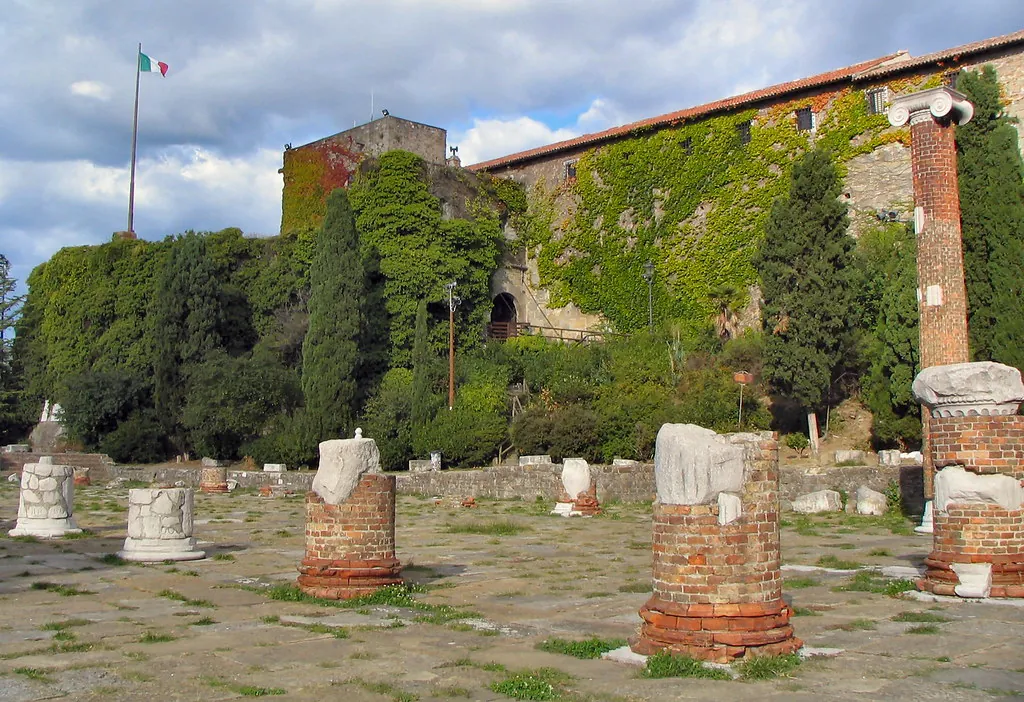
Perched on San Giusto hill above the city, this fortress is the severe, military counterpart to Miramare’s imperial romanticism. While Maximilian’s white palace was built for leisure, San Giusto was built for control. Construction stretched from 1468 to 1636, and the result is a layered architectural record of changing defensive technology across two centuries. The three bastions — the Round (Venetian), the Lalio (Hoyos), and the Fiorito (Pomis) — each reflect the artillery standards of their respective eras, and you can read the evolution of military thinking simply by walking from one corner of the fortress to the next.
Inside, the Civico Museo del Castello di San Giusto houses an extensive armory, and the Lapidario Tergestino in the Lalio Bastion displays classical antiquities from the region’s Roman past. At the entrance vestibule, built in 1557, visitors pass local stone plaques dating from the 16th through 19th centuries alongside the original bell-striking automata known as “Michez and Jachez,” salvaged from the old Trieste town hall. The sentry walkways along the ramparts give unobstructed 360-degree views of the city, the Adriatic, and the Karst hills — the kind of panorama that makes the ticket price feel like an absolute bargain.
Standard admission is €7.00, with reduced rates at €5.00. School and university groups pay just €1.00. On the first Sunday of every month (the national #domenicamuseo initiative) and on November 3rd, the Feast of San Giusto, entry is completely free. The ascent is steep, so most visitors take the San Giusto elevator embedded in the hill, then walk back down through the medieval streets into the city center.
Duino Castle
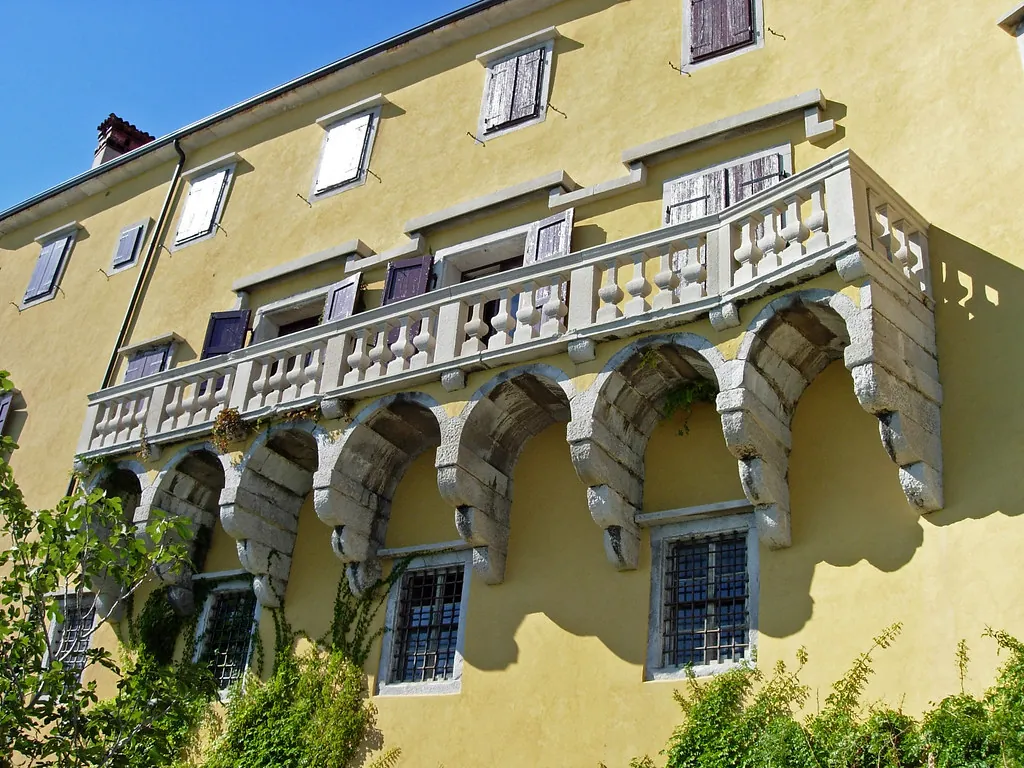
About 12 kilometers up the coast from Miramare, Duino Castle has origins stretching back to the 1300s, built on the ruins of a Roman military outpost. Where Miramare is a product of 19th-century Imperial taste, Duino is genuinely old, and the difference is palpable the moment you arrive. The estate is still owned by the Princes of Thurn und Taxis, who have maintainted it as a private aristocratic residence and cultural salon for centuries. The guest list over the years has included European emperors, renowned composers, and several of the most significant poets in European literary history.
The site is actually two things at once: the inhabited, manicured castle with its panoramic park of ancient trees and flowering terraces, and the 11th-century ruins of the Old Castle (Castello Vecchio) on an adjacent rocky outcrop. The park drops steeply to the sea, and the views from the ramparts are widely considered among the finest on the upper Adriatic. Dolphins are spotted from the walls often enough that it’s no longer a surprise to visitors who spend time there.
Adult admission to the main castle is €12.50; seniors over 65 pay €10.00, students with valid ID pay €9.00, and children between 7 and 17 pay €7.00. A family ticket (two adults with at least two children) reduces the cost for each additional child to €1.00. Entry to the Old Castle ruins alone is €5.00, or the combined ticket for both is €15.00. The castle is open daily from mid-March through the tourist season; in winter it operates weekends and public holidays only, from 9:30 AM to 4:00 PM.
The Rilke Trail
The Rilke Trail connects the village of Duino to the harbor at Sistiana along approximately 4.5 to 5.2 kilometers of Karst coastline, suspended at the edge of the Duino Cliffs Nature Reserve high above the northernmost tip of the Adriatic. The trail’s name comes from Rainer Maria Rilke, the Bohemian-Austrian poet who lived as a guest at Duino Castle between 1911 and 1912 and wrote the Duino Elegies while staring out at this precise stretch of sea. Walking the path, you start to understand why.
The terrain is classified as easy hiking — roughly 1.5 to 2 hours for the full length, with minimal elevation gain between 50 and 164 meters. The limestone has been carved by water and wind into jagged formations interspersed with Mediterranean scrub, dense pine, and sheer white cliffs dropping into blue water below. Along the route there are abandoned World War II bunkers and natural cave windows cut through the cliff face that frame the open sea like rough stone portals. The path is rocky in most sections — sturdy footwear is genuinely necessary, and it’s not suitable for strollers or anyone with significant mobility limitations. For visitors based at Miramare, taking the regional bus to Duino and combining the castle visit with the Rilke Trail is a natural, well-paced half-day itinerary.
The Napoleonica Trail
If the Rilke Trail offers dramatic coastal exposure, the Napoleonica is its calmer, more elevated counterpart. Officially the Strada Vicentina (designed by engineer Giacomo Vicentini in 1821), the path is known locally as the Napoleonica because of a persistent local legend that Napoleon’s troops were the first to cut the route through these hills after taking Trieste in 1797. Whether or not that’s true, the name has stuck firmly.
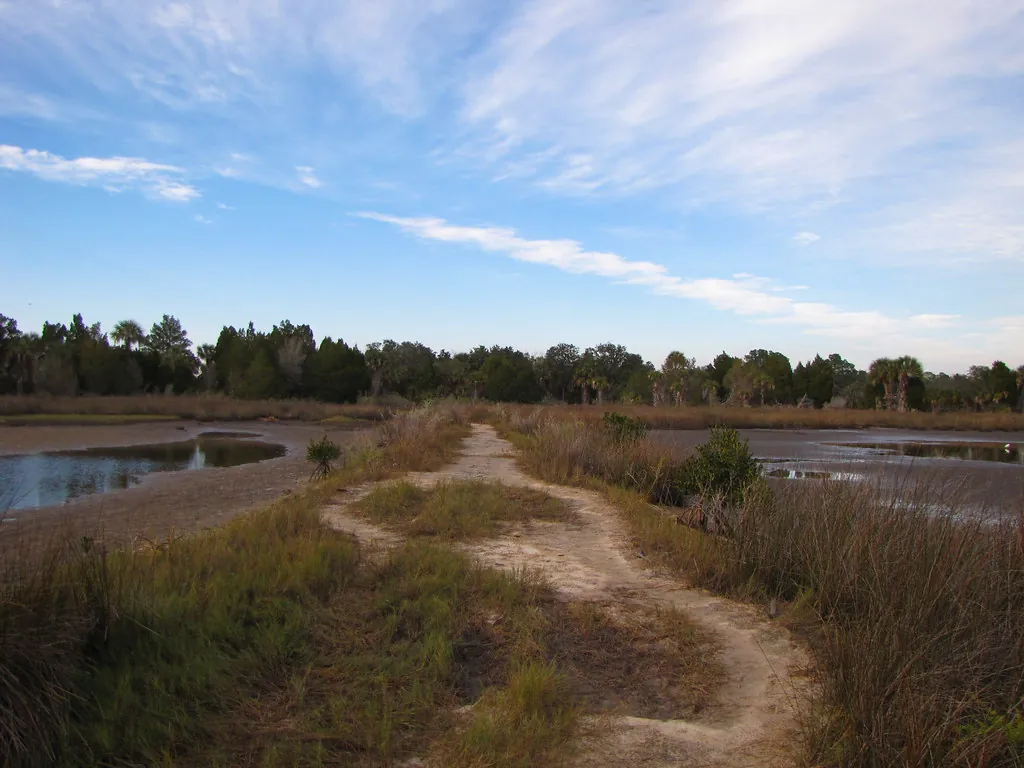
The 5-kilometer route runs along the Karst ridge between Opicina and Prosecco, hovering between 276 and 343 meters above sea level. The views from this height are continuous and extraordinary: on a clear day, the panorama stretches from the Istrian peninsula in Croatia, across the full urban spread of Trieste and the white promontory of Miramare, all the way to the snow-covered peaks of the Julian Pre-Alps. The trail surface is wide and flat, transitioning from gravel to paved asphalt near Opicina, which makes it genuinely accessible to casual walkers, families with strollers, and cyclists. The surrounding Karst vegetation and pines also provide significant natural shelter from the Bora wind, making this one of the few outdoor routes that remains pleasant in winter.
Near the Prosecco end, the trail runs alongside vertical limestone walls that have become a hub for the regional free-climbing community, with routes for experts and training areas for beginners. Watching climbers work the faces is a genuinely entertaining way to take a break on a bench and eat something before heading back.
Grotta Gigante
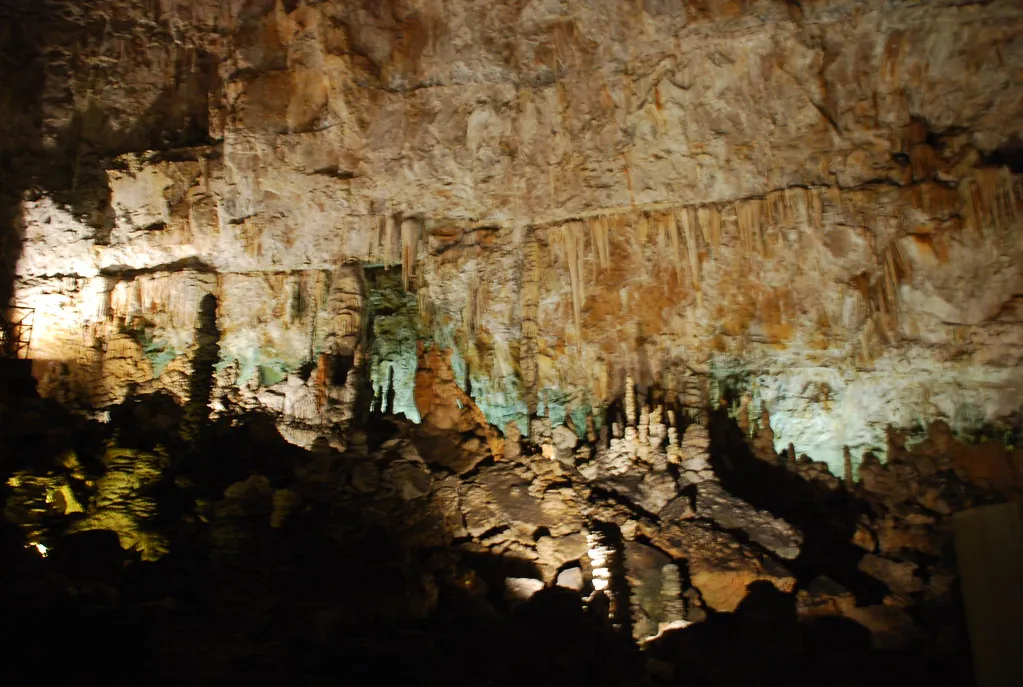
Grotta Gigante is one of the world’s largest accessible single-chamber caves, sitting beneath the Karst plateau a mere 5 kilometers or so from Miramare. The scale is genuinely hard to process: the main chamber is large enough to contain the entirety of St. Peter’s Basilica in Rome. Temperature inside is a constant 11 degrees Celsius regardless of the season, which makes it a dramatically different sensory experience from the sun-drenched coast you just came from. The descent and ascent require navigating a long, steep sequence of steps — something reviewers consistently flag as both a highlight and a practical warning for anyone with knee or mobility concerns.
Getting there from Miramare by public transit involves an inefficient two-hop routing: Bus 6 back into the city center (terminating at Piazza Oberdan), then a transfer to Bus 42 up to Borgo Grotta Gigante. The combined fare is only €2.00, but the total journey time stretches beyond two hours. A taxi from Miramare takes 13 to 17 minutes and costs roughly €24 to €31. For anyone combining the cave with the castle in a single day, the taxi is the only version of this trip that actually makes sense logistically.
Barcola and the Topolini
The Riviera di Barcola stretches north from the city toward Miramare along a coastline with roots in Roman antiquity: the elite of Tergeste (the Roman city that became Trieste) built their villas here in the Imperial era, and the ruins of Villa Giulia are still partially visible today. In the 19th century it became the retreat of the Austro-Hungarian bourgeoisie, who lined the Viale Miramare with opulent mansions. Today, Barcola is the egalitarian, densely packed epicenter of Triestine summer life, with a continuously paved waterfront of porphyry stones and sandstone slabs backed by a shaded pine forest.
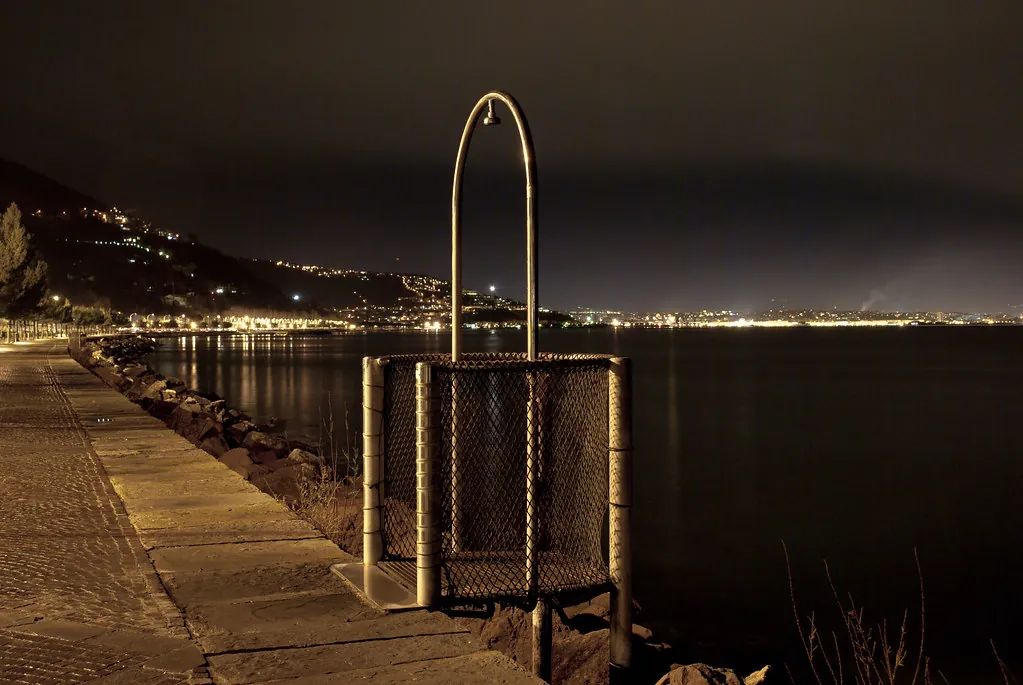
The definitive architectural signature of the whole waterfront is the Topolini: ten semicircular concrete bathing platforms designed by local architect Umberto Nordio and constructed in 1935. They were built below street level deliberately, so as not to disrupt the sea views from the coastal road above. The name — “Little Mice,” the Italian moniker for Mickey Mouse — comes from how the paired semicircular forms look from above, like two cartoon ears. The lower level of each platform has changing rooms and facilities; the upper level is a sunbathing deck with metal ladders descending directly into deep water. In peak summer, the Topolini are genuinely crowded, and teh locals will tell you that’s exactly the point — the shoulder-to-shoulder concrete terrace experience is considered quintessentially Triestine, not a flaw to be avoided.
Il Pedocin
Near the historic city center, at the end of the Molo Fratelli Bandiera, is a beach that is unique in all of modern Europe: the Bagno Marino “La Lanterna,” known in local dialect as Il Pedocin. Open since 1890, the facility has a solid three-meter wall running down the middle of the beach and extending into the sea, strictly separating male and female bathers. This is not a relic that survives through neglect. Trieste’s residents actively defend it, because on the female side, which regularly accomodates up to 3,000 daily visitors in peak summer, the segregation allows women of all ages and backgrounds to sunbathe topless, socialize loudly, and exist completely free from unwanted attention. The male side, by contrast, is quieter, defined by card games among older men and a conspicuous abundance of empty space.
The admission price is €1.20, which is itself a statement of civic philosophy: the municipality has maintained the Pedocin as a form of heavily subsidized public welfare, because access to the sea is considered a right for residents regardless of income. Capacity is legally capped at 375 women and 175 men at any one time. Hours during peak season (June 1 through September 15) run from 7:30 AM to 7:30 PM.
The Osmize
Up on the Karst plateau above Trieste, a gastronomic tradition is still running under a legal framework established by Maria Theresa of Austria in 1784. The imperial decree allowed plateau farmers to sell surplus wine and cured foods directly from their cellars to consumers, bypassing commercial taxes entirely. The permission was granted in windows of exactly eight consecutive days (the Slovenian word for eight is osem, which is precisely where the word Osmiza comes from), and that structure remains essentially intact today.
An Osmiza is a pop-up establishment inside the actual courtyard, garden, or cellar of a working farm family. Hot food is legally prohibited — the menu is always raw, cured, pickled, or preserved products made on that specific property: hard-boiled eggs, artisan cheeses, thick bread, cold cuts, and the farm’s own wine. On the Karst, those wines are the mineral-heavy white Vitovska, the aromatic Malvasia, and the fierce, iron-rich red Terrano. Prices are extremely low, seating is communal wooden tables, and spontaneous folk singing is not unusual. When an Osmiza is open, a bundle of ivy or leafy branches (a frasca) hangs at the nearest road crossroads with a red arrow pointing the way.
The province of Trieste has roughly 50 independent Osmize, each with its own erratic schedule throughout the year. Tracking which ones are currently open is handled by platforms like Osmize.com and the “Osmize a Trieste” app on iOS and Android. Getting there from the coast generally requires a car or taxi — the steep escarpment between the coast and the plateau is one place where the public bus network is genuinely not up to the task.
Risiera di San Sabba
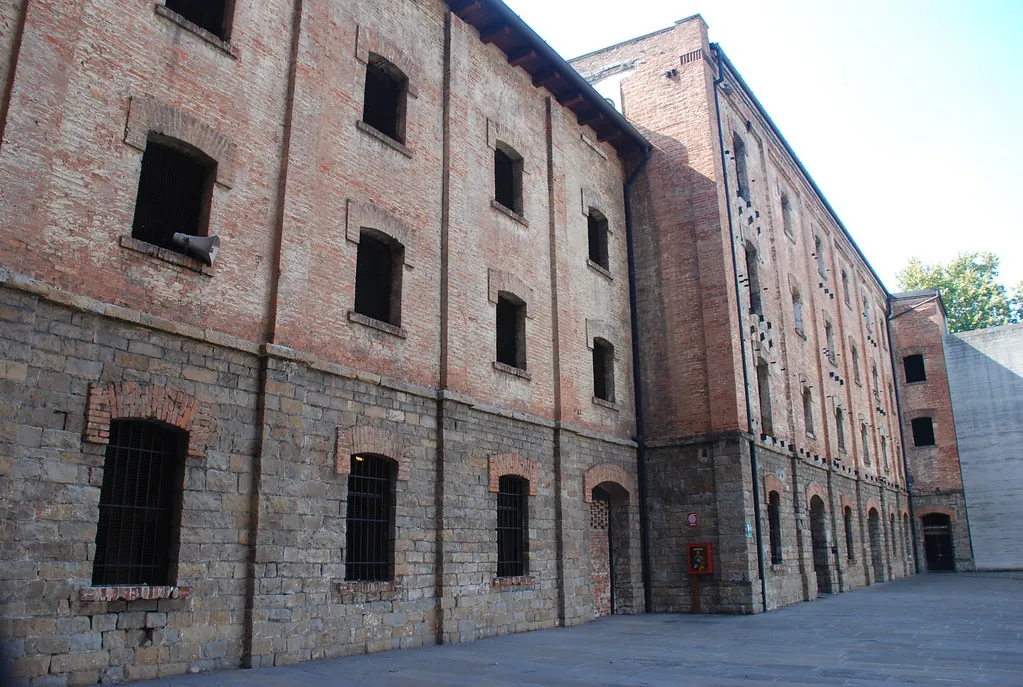
The Risiera di San Sabba sits away from the coastal tourist zones, and it is the least photographed and most important site in Trieste for understanding the full history of the region. A former rice-husking facility, it was converted by Nazi occupying forces in 1943 into a police transit camp and concentration camp. It is the only concentration camp in Italy that was equipped with a crematorium. The building is now a civic memorial and museum, free of charge year-round, and its stark brutalist architecture carries a weight that no formal historical description can fully prepare you for.
Getting Between Everything
For the coastal strip between the city center and Sistiana, the seasonal Delfino Verde ferry is the most pleasant option from late April through early October. The route runs from the Trieste port northward, stopping at Porto Vivo, Barcola, the Topolini terraces, and Grignano (the harbor directly below Miramare), before continuing to Sistiana. The journey from the city to Miramare takes 40 to 50 minutes and costs around €4.00 to €5.00 one way. Bikes are permitted (maximum 10). The same operator runs a longer seasonal route north to Monfalcone, stopping at Duino Castle.
For year-round terrestrial access, Bus 6 or 36 from the city center serves Miramare directly, and the Trenitalia regional commuter train from Trieste Centrale to the Miramare rail station takes under 10 minutes for €1.00 to €2.00. To continue north toward the Rilke Trail and Duino from Miramare, APT Gorizia regional buses (Lines G51 or 44) depart from the coastal highway and reach Duino in 16 to 28 minutes for €2.00 to €3.00. The significant limitation of the public network is lateral movement between the coast and the plateau: the hub-and-spoke design forces travelers back into the city center to switch lines, which turns a 5-kilometer geographic hop into a two-hour ordeal. Any itinerary that combines the coast with the Karst plateau on the same day is best done with a rental car or a taxi.
Faro della Vittoria
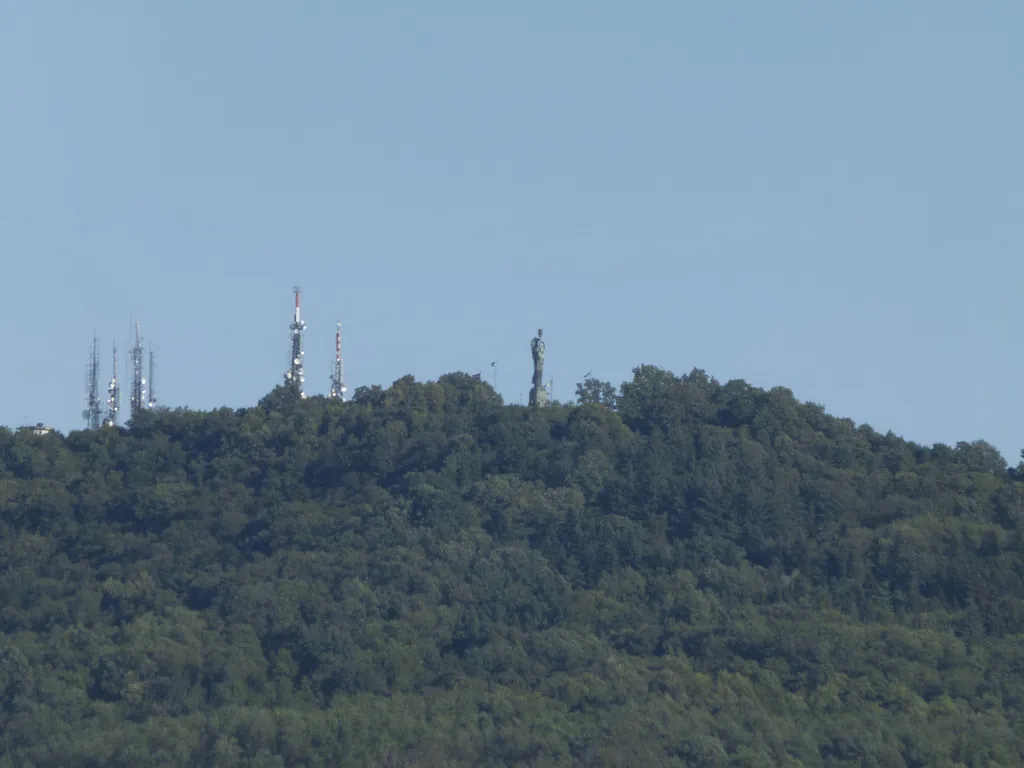
On the slopes of Gretta Hill, the Faro della Vittoria (Victory Lighthouse) is among the tallest lighthouses in the world and also a monument to those who died at sea in the First World War. It is free to visit, but access to the viewing tower is capped at 15 people at a time, with each group limited to 15 minutes inside. The lighthouse runs on a seasonal calendar from early April through the first week of November, open primarily on Fridays, Saturdays, and Sundays during shoulder season, with Wednesdays and Thursdays added in July and August. A complimentary guided tour runs at 3:00 PM on operational days. The site closes immediately in high winds, and no animals are allowed inside the tower.