Cinematic History: Film and Television Productions at Miramare
The Cinematic Canvas of Miramare
Miramare Castle is a primary location for European historical storytelling. The structure sits directly on a rocky promontory in the Gulf of Trieste. Archduke Ferdinand Maximilian of Habsburg commissioned the project in 1856. Austrian architect Carl Junker designed the estate using a strict eclectic fusion of Gothic, Medieval, and Renaissance styles. The luminous white Istrian stone creates a high-contrast backdrop against teh Adriatic Sea. This stark visual definition makes the site exceptionally valuable for cinematic framing.
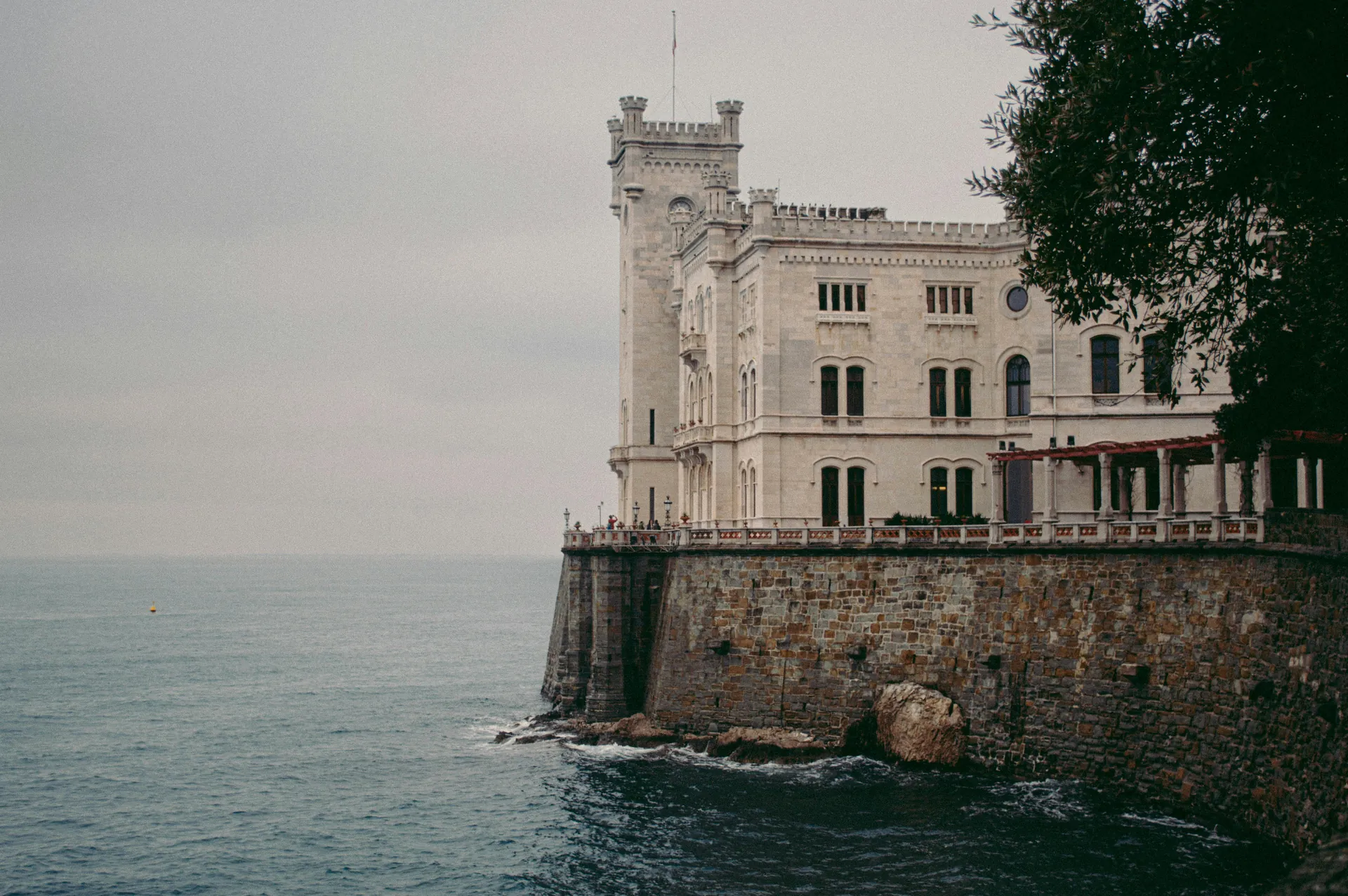
The name Miramare translates directly to ‘look at the sea’ in Italian. The building fulfils this exact mandate. Cinematographers favour the location because the geographical orientation allows for long, uninterrupted natural exposures across the water. The sun rises over the Karst plateau and sets directly into the Adriatic, granting film crews a predictable and prolonged golden hour. This lighting environment is notoriously difficult to replicate in studio settings.
The Architectural Muse: From Visconti to Modern Epics
Filmmakers frequently utilize the site to capture the opulence and subsequent decay of the Habsburg legacy. Xaver Schwarzenberger’s 2010 miniseries Sissi utilised the castle’s extensive terraces and formal interiors to establish the decadence of the Habsburg era. Schwarzenberger placed his actors against the rigid geometry of Junker’s design to highlight the structural rigidity of the Austrian Empire. Modern researchers examining Schwarzenberger’s production files note that the estate’s management permitted extensive physical access. Crews laid heavy dolly tracks directly onto the original paving stones.
The “Curse of Miramare” dictates that anyone who sleeps in the castle will die prematurely in a foreign land. This dark historical undercurrent frequently informs the atmospheric tension in Italian cinema.
Current conservation protocols under CoopCulture are far more restrictive. Commercial productions face rigid weight limitations for camera equipment inside the historical rooms. Despite these limitations, the interior spaces remain highly sought after for historical dramas. The “Novara” room is an exact replica of Maximilian’s naval cabin. Blue nautical-themed wall hangings line the adjacent halls. The heavy wood panelling in the Novara room absorbs ambient light, requiring directors of photography to rely on practical, period-accurate candle or oil lamp simulations. These distinct rooms featured heavily in international productions, including Riccardo Milani’s 2008 adaptation of Rebecca. Milani used the cramped, authentic dimensions of the rooms to amplify the psychological tension between his characters.
The Istrian Stone and Cinematography
The physical composition of Miramare Castle is an asset to directors of photography. The entire structure consists of white Istrian stone. This dense limestone is native to the nearby Istrian peninsula and possesses a remarkably high albedo. It reflects sunlight with intense clarity. During the early days of Italian neorealism and post-war cinema, this natural reflectance allowed filmmakers to shoot clear exterior scenes with slower, less sensitive film stocks. The stone catches the harsh Mediterranean sun and disperses it, functioning as an architectural bounce board. This effect softens the shadows on actors’ faces when they stand near the sea-facing balustrades.
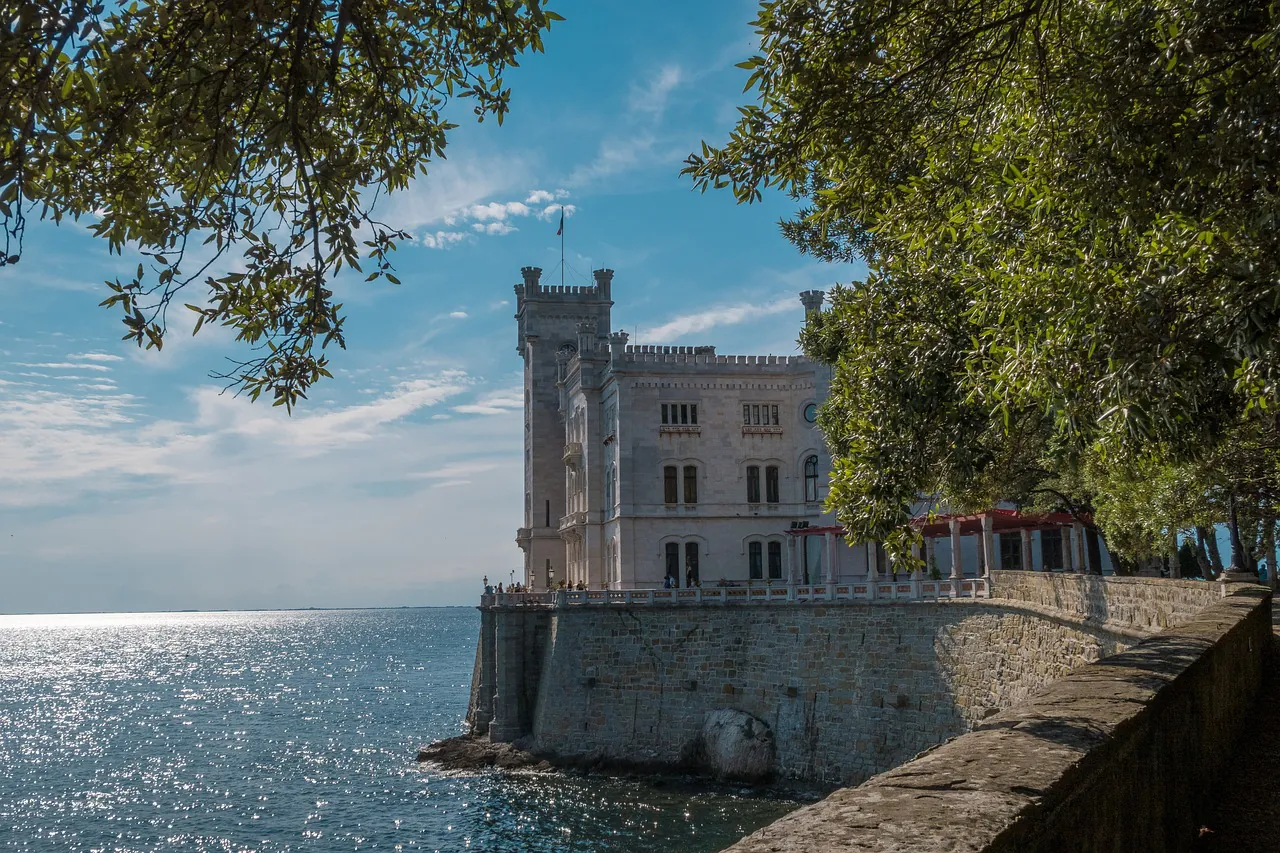
When the Bora winds sweep the cloud cover away, the contrast between the glaring white stone and the deep blue of the Adriatic is absolute. Colour film stocks from the 1960s and 1970s often struggled with this extreme dynamic range, resulting in the slightly overexposed skies seen in vintage travelogues. Modern digital sensors handle the exposure latitude far better, but the visual impact remains unchanged. The building dominates the frame through sheer luminance. This brightness directly contrasts with the dark, heavy wood panelling found inside the royal apartments, forcing a stark visual transition every time a character moves from the exterior terraces into the interior rooms.
The Park as a Set and the Archive of Memory
The 22-hectare botanical landscape is a controlled environment for period-accurate exterior sequences. Maximilian imported diverse flora to create an extensive, multi-tiered garden complex. He planted Californian sequoias, Lebanese cedars, and Spanish firs to construct a global botanical collection. These mature trees now act as massive natural light diffusers. The dense canopy allows crews to shoot mid-day scenes without harsh overhead shadows.
The grounds require zero modern set dressing to simulate 19th-century European aristocratic life. The Castelletto and the historic kitchens underwent complete restoration in 2023. These updated areas present new, structurally sound interior locations for both documentary and commercial filming. The Castelletto originally functioned as a temporary residence for Maximilian and Charlotte while the main structure was under construction. Its smaller scale makes it acoustically favourable for dialogue-heavy scenes.
The Italian public broadcasting network, RAI, maintains a vast catalogue of material detailing the Habsburgs in Trieste. Twentieth-century cinematic newsreels, known as Cinegiornali, documented the estate’s transition from an imperial residence to a public monument. The Istituto Luce archives hold pristine black-and-white footage of the Duke of Aosta, who inhabited the castle in the 1930s before his death in a WWII prisoner camp.
Documentaries often focus on the tragic narrative of its original inhabitants. Maximilian faced execution in Mexico in 1867. Charlotte descended into severe mental illness, surviving him by sixty years in absolute isolation back in Belgium. Directors rely heavily on the visual contrast between the bright, idyllic setting of Miramare and the grim historical reality of its owners. This juxtaposition is a recurring motif in European historical television programming.
Technical Logistics for Film Crews
Producing content at the Museo Storico e il Parco del Castello di Miramare requires strict adherence to environmental and structural regulations. The surrounding waters are a highly regulated Marine Protected Area managed by WWF Italy since 1986, which visiting location scouts must account for. Boats cannot anchor near the promontory. Underwater filming requires specific marine biological permits. The sound department must also prepare for the Bora. This severe, katabatic wind frequently strikes the Gulf of Trieste with speeds exceeding 100 kilometres per hour. The Bora makes exterior audio recording nearly impossible and poses a physical danger to overhead lighting rigs.
The site coordinates are 45.705002, 13.712391. Several 2026 infrastructure updates directly impact wide-angle exterior photography. Construction on the Grignano Lift Footbridge commenced in January 2026. This structure creates a temporary visual obstruction along the northern approach from the Grignano bay. Directors must frame their shots tightly to avoid capturing the heavy machinery currently stationed along the cliff base. The ‘Trieste Spring Run’ on 3 May 2026 forces a total traffic closure along Viale Miramare between 6:00 AM and 3:00 PM. Crews must adjust transport schedules and basecamp placements accordingly.
| Logistical Category | Requirement / Current Status (April 2026) |
|---|---|
| Site Designation | Protected National Museum & Marine Reserve |
| Exterior Lighting | Natural exposures; limited overhead rigging allowed |
| Infrastructure Impact | Grignano Lift Footbridge construction in progress |
| Commercial Filming | Official permits required via FVG Film Commission |
| Academic Access | Archive access via official museum portal |
Visiting the Locations: A Cinephile’s Guide
Cinephiles and researchers planning a physical survey of the estate need to map their itinerary around the specific administrative zones. Entry to the museum is €17.00. This standard ticket currently includes mandatory access to the ‘A SPHINX ATTRACTS HIM’ exhibition. The building operates from 9:00 AM to 7:00 PM, with the final entry permitted at 6:30 PM. The expansive gardens are entirely free year-round and open at 8:00 AM.
Visitors frequently ask how long to spend on the grounds. A comprehensive technical scout or historical review requires at least three hours to cover both the interior rooms and the coastal pathways. You can walk the exact gravel paths where Cristiana Capotondi filmed her tense exchanges in Sissi. The stone balustrades remain untouched since the 2010 production. The primary difference is the strict modern prohibition against leaning on or mounting equipment to the historical stonework.
Those studying the cinematic footprint of the region can coordinate their research through the FVG Film Commission. You can also explore local hospitality and regional transport details via the official Trieste Tourism Board. A visit to Miramare is a direct encounter with European film history. The castle is a static actor in decades of visual storytelling, maintaining its severe, aristocratic posture against the changing tides of the Adriatic.